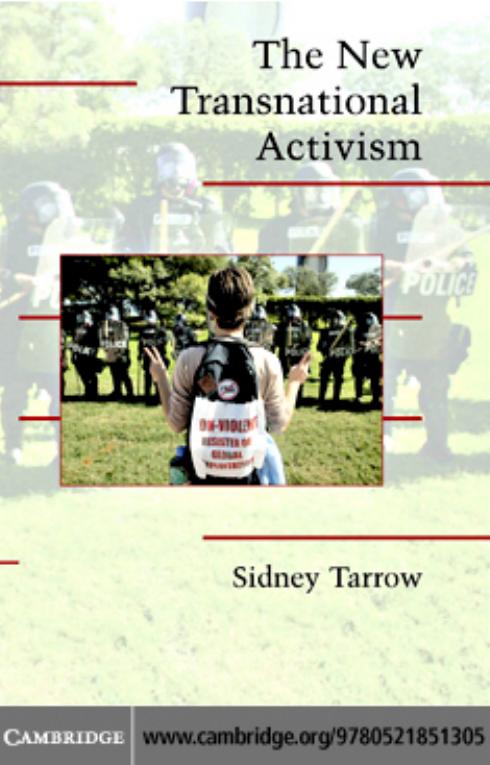
The New Transnational Activism by Sidney Tarrow
Author:Sidney Tarrow [Tarrow, Sidney]
Language: eng
Format: epub, pdf
ISBN: 9780521616775
Amazon: 0521616778
Publisher: Cambridge University Press
Published: 2005-08-02T00:00:00+00:00
Both relational and nonrelational paths broadened the reach of political Islamism. Early developments in electronic technology helped to spread the message. Audiocassettes, which had been important instruments in the Iranian revolution, became transnational means of communication in the 1980s. They were “less a sign of direct intergroup cooperation than the pop- ularity of topics and speakers who have developed a following large enough to allow modest profits to the informal network of kiosk venders who distribute them” (p. 32). There were also direct connections fostered by religious figures and scholars. Unlike Catholicism, Islam has no central hi- erarchy that can certify or decertify religious teachers or mosques. This made it easy for self-styled imams to establish mosques throughout the Muslim world and in the centers of immigration in Europe. Mosques be- came sites for social appropriation in which “Muslim activists are likely to borrow from one another through face-to-face encounters and collect the literature of like-minded groups” (p. 32).
But scale shift is more than a horizontal diffusion process: a series of bridging relationships both spread the movement beyond Afghanistan and shifted it vertically to a higher level. As the most dynamic society in the Middle East, Egypt was for years at the core of the movement. The Muslim Brotherhood was the most prominent of the national Islamist movements, and academics from across the Islamic world who studied in Cairo made contact there with adepts of the Brotherhood, returning to their home countries to help found youth movements, such as the one founded at Kabul University in the late 1960s (p. 33).
Not all those who played a brokerage role were sympathetic to the actors they brought together. In its obsession with turning back the Soviet advance in Afghanistan, the United States recruited and trained mercenaries to fight against the Soviet-backed regime through the intermediary of the Muslim Brotherhood and Saudi Arabia. “In the 1980s,” writes Eickelman, “Afghan resistance became a ‘joint venture’ of the Muslim Brotherhood and the Saudis, with tacit U.S. support” (p. 37). Once connected to one another, “Afghan Arabs” who had fought in Afghanistan became a restless transna- tional force, and many of their camps became training grounds for militants who moved elsewhere to coordinate new insurgencies. One camp in Paktya province trained Kashmiri militants, Philippine Moros, and Palestinian Is- lamists, many of whom offered their services and their military expertise to other Islamist movements in the Middle East (pp. 37–8). This was the main source of the transnational movement we know today as Al Qaeda, which coordinates and finances insurgencies around the globe. It has narrowed its repertoire of contention from the wide range of collective claims making that characterized Islamism in domestic politics to an almost unique focus on causing death and destruction.
The South Asian, Egyptian, and Iranian activists who were the intel- lectual sources of the first Islamist groups probably had no inkling of the global range of the movement that would grow out of their writings. Indeed, without exception, their targets were the secular nationalist regimes of their own countries.
Download
The New Transnational Activism by Sidney Tarrow.pdf
This site does not store any files on its server. We only index and link to content provided by other sites. Please contact the content providers to delete copyright contents if any and email us, we'll remove relevant links or contents immediately.
| Elections & Political Process | Ideologies & Doctrines |
| International & World Politics | Political Science |
| Public Affairs & Policy | Specific Topics |
| United States |
The Secret History by Donna Tartt(18962)
The Social Justice Warrior Handbook by Lisa De Pasquale(12171)
Thirteen Reasons Why by Jay Asher(8856)
This Is How You Lose Her by Junot Diaz(6842)
Weapons of Math Destruction by Cathy O'Neil(6223)
Zero to One by Peter Thiel(5741)
Beartown by Fredrik Backman(5687)
The Myth of the Strong Leader by Archie Brown(5470)
The Fire Next Time by James Baldwin(5392)
How Democracies Die by Steven Levitsky & Daniel Ziblatt(5181)
Promise Me, Dad by Joe Biden(5118)
Stone's Rules by Roger Stone(5058)
A Higher Loyalty: Truth, Lies, and Leadership by James Comey(4917)
100 Deadly Skills by Clint Emerson(4888)
Rise and Kill First by Ronen Bergman(4743)
Secrecy World by Jake Bernstein(4709)
The David Icke Guide to the Global Conspiracy (and how to end it) by David Icke(4662)
The Farm by Tom Rob Smith(4474)
The Doomsday Machine by Daniel Ellsberg(4460)
